BOOK REVIEW
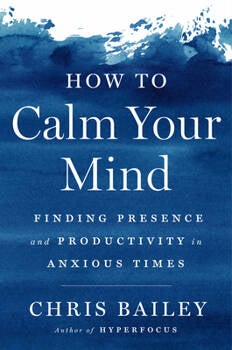
How to Calm Your Mind: Finding Presence and Productivity in Anxious Times
By Chris Bailey
Penguin Life Publishing, 288 pages, 2022
In a world that equates "busy" with "important," Chris Bailey’s How to Calm Your Mind arrives like a deep, much-needed exhale. Bailey, a productivity expert known for his intensive self-experiments, takes a sharp turn away from his usual "do more" ethos to explore a more fundamental requirement for a meaningful life: the state of calm.
The Productivity Paradox
The core premise of the book is that our collective anxiety isn't just a byproduct of our fast-paced lives; it is a direct barrier to our effectiveness. Bailey argues that when we are chronically stressed, our cognitive "bandwidth" shrinks. We become reactive rather than intentional. By seeking calm, we aren't just feeling better; we are actually reclaiming the mental space required to do our best work and enjoy our downtime.
Bailey identifies the "Anxiety-Productivity Loop"—a cycle where we feel behind, so we work harder, which increases our stress, which then lowers our efficiency, making us feel even further behind. Breaking this loop requires a counterintuitive move: slowing down to speed up.
The Dopamine Trap
One of the book’s most compelling sections focuses on the neurochemistry of our modern distractions. Bailey distinguishes between "super-stimuli" (social media, endless news cycles, processed sugar) and lower-stimulation activities that provide lasting satisfaction.
He explains how our constant pursuit of dopamine hits keeps us in a state of "craving" rather than "having." To combat this, he suggests a "dopamine detox"—not necessarily a total withdrawal from the modern world, but a conscious effort to lower our baseline stimulation so that simple, analog pleasures can become rewarding again.
Key Strategies for a Calmer Mind:
• The Rule of Three: Choosing only three main intentions for the day to prevent overwhelm.
• Analog Time: Designating specific hours to be completely disconnected from digital devices.
• The "Savory" Practice: Intentionally slowing down during everyday tasks—like drinking tea or walking—to fully engage the senses.
• Mindful Meditation: Using breathwork not as a "hack," but as a way to build "mental muscle" against reactivity.
Strengths and Weaknesses
Bailey’s writing is refreshingly candid. He doesn't position himself as a serene guru but as a fellow traveler who has struggled with burnout and anxiety. His advice is grounded in research but delivered with a conversational wit that makes complex neuroscience feel accessible.
However, some readers might find the transition from "productivity" to "calm" a bit jarring if they were expecting a traditional time-management manual. This is less a book about how to use a planner and more about why your brain is too fried to use one in the first place. Some of the suggestions—like taking a month-long break from the internet—may also feel out of reach for those in high-pressure corporate roles, though Bailey does offer "lite" versions of these experiments.
Final Verdict
How to Calm Your Mind is a vital read for anyone who feels like they are running on a treadmill that keeps getting faster. It is a persuasive argument for the idea that calm is a superpower. In an economy of attention, the ability to remain centered is the ultimate competitive advantage.
Author Biography: Chris Bailey
Chris Bailey is an internationally recognized productivity expert and the bestselling author of The Productivity Project and Hyperfocus. His work has been translated into over 30 languages and featured in outlets such as The New York Times, The Wall Street Journal, and Harvard Business Review.
Bailey gained notoriety for his "Year of Productivity," during which he conducted extensive self-experiments—such as living in total isolation for ten days and waking up at 5:30 AM every morning—to discover what truly makes people efficient. He lives in Kingston, Ontario, with his wife, Ardyn, and continues to explore the intersection of focus, mindfulness, and the meaningful life.
Add comment
Comments