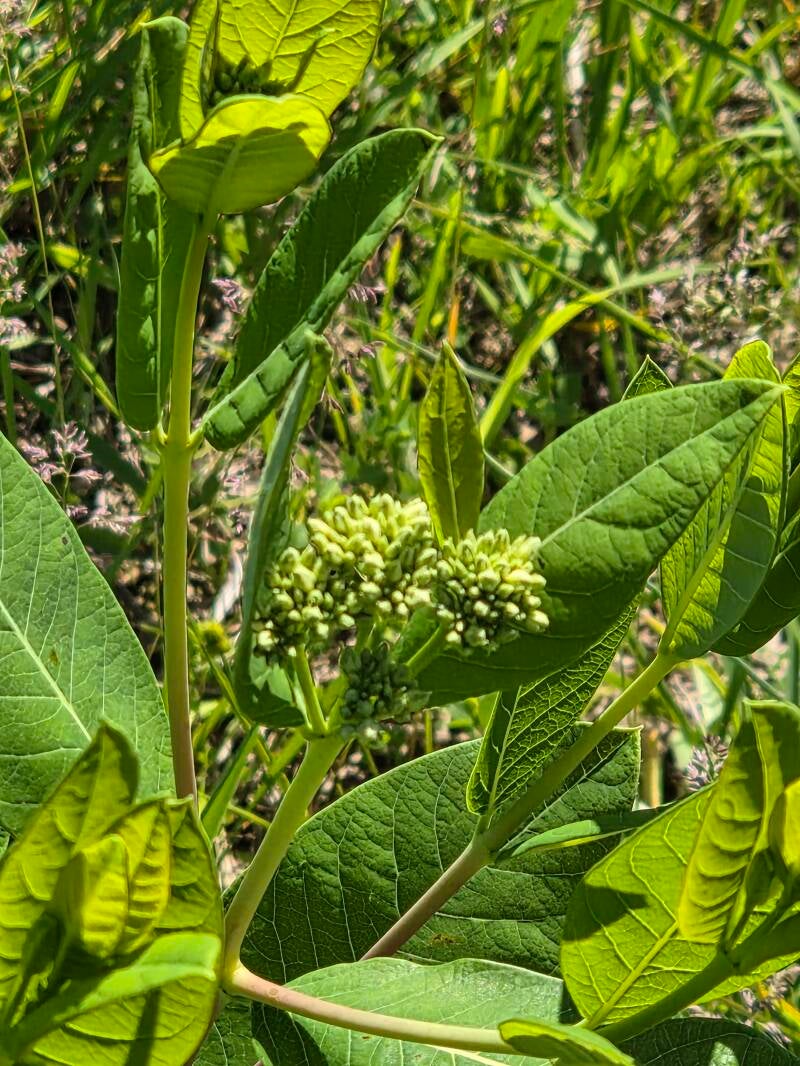
Dogbane Plant and the Earthworks of Fortified Hill
In the sun-drenched meadows of the American Midwest, a slender, reddish-stemmed plant stands as a testament to the dual nature of the botanical world. Apocynum cannabinum, commonly known as Dogbane or Indian Hemp, is a species that commands respect. To the casual observer, it is a hardy perennial; to the herbalist, it is a potent (and dangerous) medicine; and to the indigenous peoples of North America, it was one of the most vital technological resources in their daily lives.
In Hamilton, Ohio, this plant finds a particularly storied home near the site of Fortified Hill, a prehistoric earthwork that underscores the deep temporal connection between the land’s flora and its human history.
Understanding Dogbane: Botany and Identification
Dogbane is often mistaken for Common Milkweed (Asclepias syriaca) because both exude a thick, white milky sap when broken. However, Dogbane is more branched, has smaller, opposite leaves, and produces clusters of tiny, greenish-white bell-shaped flowers.
The plant’s name is literal: Apocynum translates from Greek to "away from dog." It contains cymarin, a cardioactive glycoside similar to digitalis. If ingested by livestock or pets, it can cause cardiac arrest, making its presence in grazing pastures a concern for farmers. Yet, for those who knew how to harness its fibers, Dogbane was not a weed to be eradicated, but a harvest to be sought.
The "Indian Hemp": A Legacy of Fiber
Long before the introduction of European flax or industrial cotton, Dogbane was the primary source of high-quality cordage for Native American tribes, including the Shawnee and Miami who inhabited the Ohio Valley.
The inner bark of the stalk contains bast fibers that are remarkably strong, silky, and resistant to decay in water. The process of harvesting and processing Dogbane is a seasonal ritual:
1. Harvesting: Stalks are collected in late autumn or early winter after the plant has turned a deep reddish-brown and the leaves have fallen.
2. Splitting: The woody outer stem is cracked open to reveal the ribbon-like fibers inside.
3. Processing: The fibers are "buffed" or rubbed between the hands to remove the brittle outer bark.
4. Spinning: Using a thigh-rolling technique, the fibers are twisted together to create two-ply cordage.
This cordage was used for everything from fishing nets and bowstrings to fine thread for clothing and heavy-duty rope for lashing bark onto lodge frames.
Historical and Medical Uses
The medicinal history of Dogbane is complex and fraught with risk. It has been used in various traditions, though always with extreme caution due to its toxicity.
• Native American Traditions: Various tribes used a weak decoction of the root to treat dropsy (edema) and as a potent diuretic. It was also employed as a treatment for intestinal worms and fevers.
• 19th-Century Pharmacy: In the 1800s, Dogbane was listed in the U.S. Pharmacopoeia. Physicians used it as a cardiac stimulant and to induce vomiting (emetic) in cases of accidental poisoning.
• Modern Safety Note: Due to the cardiac glycosides, Dogbane should never be used for internal medicinal purposes without professional supervision. It is far more valuable today as a material for traditional crafts than as a home remedy.
The Sacred Landscape: Fortified Hill, Hamilton, Ohio
In the southwest corner of Hamilton, Ohio, perched on a high ridge overlooking the Great Miami River, lies Fortified Hill. This site is an exceptional example of an ancient hilltop enclosure.
Construction and Purpose
Built by the Hopewell culture (roughly 100 BCE to 400 CE), Fortified Hill is defined by a massive wall of earth and stone that follows the natural contours of the ridge. Unlike the "forts" of European history, these enclosures were likely not designed for warfare. Instead, archaeological evidence suggests they were sacred ceremonial spaces.
The walls at Fortified Hill enclose roughly 16 acres. The engineering is precise; the Hopewell utilized the steep ravines of the hillside as natural defenses, augmenting the gaps with man-made embankments.
The Squier and Davis Records
The site gained international recognition in 1848 when it was featured in Ancient Monuments of the Mississippi Valley by E.G. Squier and E.H. Davis. Their meticulous surveys provided a glimpse into the site before modern development and agriculture began to erode the embankments. They described the gateway—a complex "T" shaped entrance—that signaled the transition from the mundane world to the ritual space inside the enclosure.
Preservation and Today
For decades, Fortified Hill was privately owned and largely inaccessible to the public. However, through the efforts of the Pyramid Hill Sculpture Park & Museum and various conservation groups, the site has been preserved. Today, it stands as one of the few hilltop enclosures in the Ohio Valley that has not been completely leveled by the plow.
The vegetation around the hill remains a living link to the past. Dogbane continues to grow along the edges of the woods and in the clearings near the Great Miami River, just as it did when the Hopewell people gathered it to weave the nets used to catch fish in the waters below.
How to Use Dogbane Today: A Guide to Cordage
While its medicinal use is discouraged, learning to make cordage from Dogbane is a profound way to connect with the history of Hamilton and the indigenous technologies of the Ohio Valley.
Identifying the Dry Stalks
In late November, look for tall, spindly, red-brown stalks in open fields or near the edges of the Great Miami River. The stalks will be dry and brittle.
The Processing Steps
1. Test for Strength: Break a small piece. If the fibers inside are grey and dusty, they have rotted. If they are white or tan and difficult to snap, they are perfect.
2. Flatten the Stalk: Use your thumb to flatten the stalk from bottom to top.
3. Peel the Fiber: Carefully peel the long strips of fiber away from the woody "pith" in the center. Throw the pith back into the soil.
4. Clean the Fiber: Rub the strips between your palms. The brown outer "skin" will flake off, leaving you with a bundle of soft, blonde fibers.
The Leg-Roll Technique
Take two thin bundles of fiber. Hold them at the top with your left hand. Lay them across your right thigh. With your right palm, push both bundles downward (toward your knee) so they twist individually. Then, pull your hand back upward, catching both bundles so they twist around each other. This creates a "reverse-twist" cord that will not unravel.
A Living Connection
To stand on the embankments of Fortified Hill is to stand in a place where the barrier between the past and present feels thin. Looking down the slope toward the river, you see the same plants that the Hopewell saw 2,000 years ago.
And you can see it for yourself too. Guided tours for Fortified Hill in Hamilton, Ohio, are managed by Pyramid Hill Sculpture Park & Museum. There is a fee and tours are limited. Because the site is a sensitive prehistoric earthwork, access is generally a scheduled guided experience and covers a walk of a little over a mile. It was such an amazing experience, so peaceful and I learned so much. Plus I went on a wonderful sunny day with good friends It is definitely worth the visit. Especially exciting as I got to see the Dogbane up close and personal.
• Official Registration Page: You can find the tour listings and purchase tickets at pyramidhill.org/fortifiedhill
The Dogbane is more than just a plant; it is a thread—literally and metaphorically—that ties the geology of the Hamilton ridges to the ancient people who shaped them and the modern residents who seek to preserve them. Whether you are interested in the botanical properties of the "Bitter Root" or the monumental achievements of the Hopewell architects, the landscape of Hamilton, Ohio, offers a unique window into a world where humans and plants lived in a sophisticated, sustainable rhythm.
Add comment
Comments