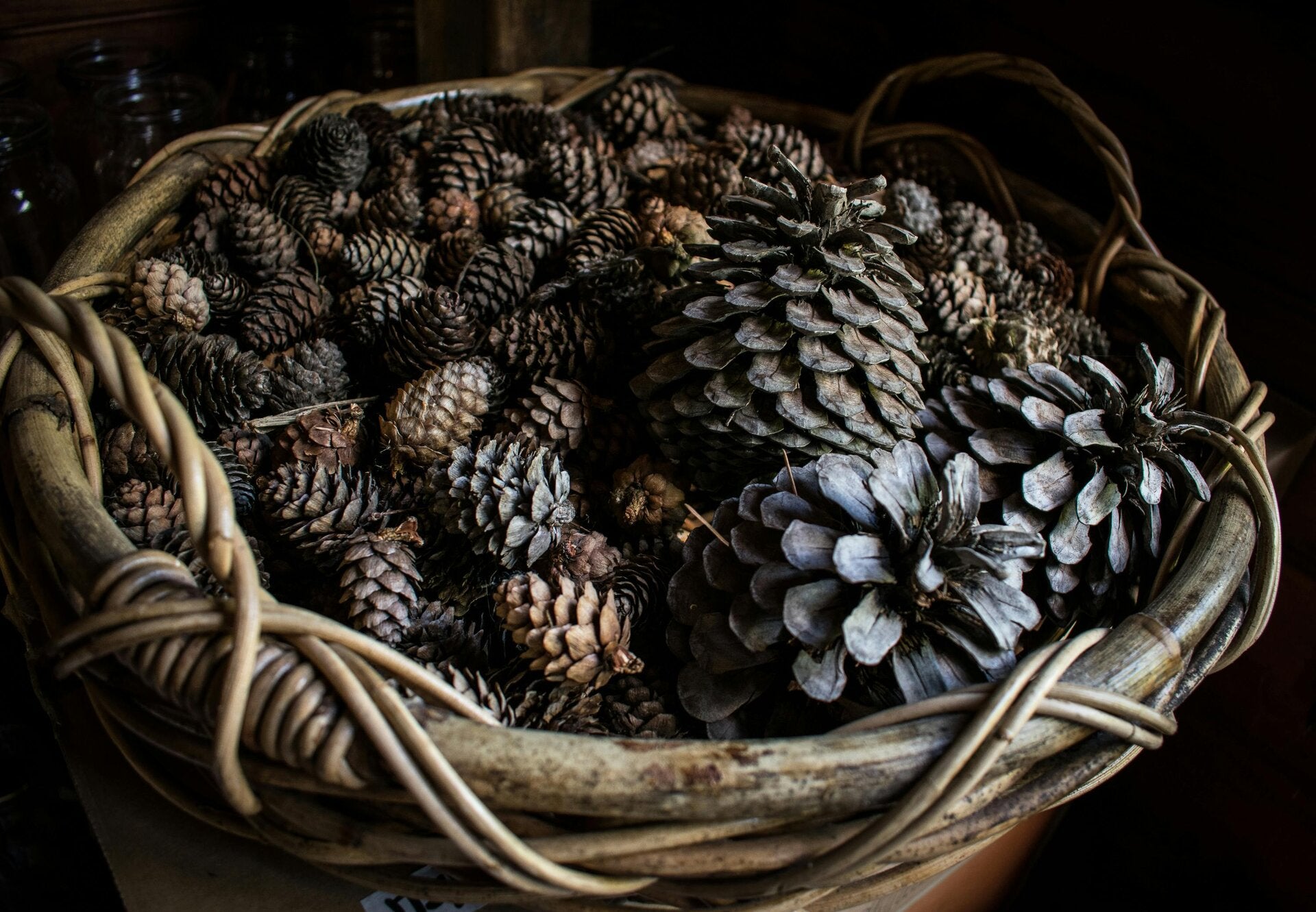
The Pinecone… Crafting Protection for the Home
If you grew up in a household with Northern European roots, you might remember a curious figure dangling above the stove or perched near the window: a small, often "homely" doll with a pointed hat, a wooden spoon, and a broomstick. This is the Kitchen Witch, a folk talisman believed to bring good luck and ward off culinary disasters.
While she is a staple of mid-century kitsch, her history is a fascinating blend of ancient folklore, domestic superstition, and the evolution of the "wise woman" archetype.
Ancient Roots: From Spirits to Poppets
The concept of a domestic protector is as old as the hearth itself. Long before the Kitchen Witch took her modern form, ancient cultures worshipped deities of the home. The Romans had the Lares, spirits who protected the household, while Slavic folklore told tales of the Domovoy, a bearded spirit living behind the stove who required offerings of milk or bread to keep the peace.
The specific "witch" imagery likely emerged from Northern Europe, particularly Scandinavia and Germany. In these regions, the line between a helpful household spirit and a magical practitioner was often blurred. By the time the Middle Ages arrived, the "wise woman" of the village—the one who knew which herbs cured a fever or helped bread rise—became the blueprint for the Kitchen Witch.
The Superstitions of the Stove
The Kitchen Witch wasn't just there for decoration; she had a job to do. Historically, the kitchen was the most dangerous and unpredictable room in the house. A fire could go out, milk could sour for no apparent reason, and a single batch of ruined bread could mean a hungry family.
To prevent these mishaps, the Kitchen Witch doll acted as a "lightning rod" for bad luck. According to tradition, having a witch in your kitchen ensured:
• The pot would never boil over.
• The bread would always rise.
• The meat would never burn.
• The sauces would never curdle.
In many traditions, these dolls were never bought for oneself. Much like a jade plant or a lucky horseshoe, the Kitchen Witch was most powerful when received as a gift, symbolizing a wish for prosperity and well-fed bellies from one friend to another.
The Mid-Century Boom
While the folklore is centuries old, the Kitchen Witch saw a massive resurgence in the 1960s and 70s. During this era, tourists traveling through Norway, Sweden, and Germany brought these handmade dolls back to North America as souvenirs.
They became a hallmark of "country-style" decor. These dolls were typically made from scrap fabric, dried apples (for the face), or resin, often accompanied by a small printed poem:
“I’m the Kitchen Witch, and I bring you good luck,
With my broom and my spoon, and a bit of good pluck.
Your pots will not burn, your milk will not sour,
I’ll watch o’er your stove every day, every hour.”
The Anatomy of the Talisman
If you are looking to add one to your home, here is what the traditional figure usually carries:
Whether you view her as a charming piece of vintage folk art or a serious guardian of the home, the Kitchen Witch remains a testament to our desire to find magic in the places we gather most. She reminds us that the heart of the home—the kitchen—is a place of transformation, where raw ingredients become sustenance and a little bit of luck always helps.
A pinecone is a fantastic choice for a kitchen witch talisman. In modern kitchen witchery, a talisman doesn't have to be the traditional "poppet" or doll; it can be any natural object that you’ve infused with the intention of protecting your home and hearth.
Pinecones are particularly well-suited for the kitchen because of their deep-rooted associations with protection, abundance, and the fire of the hearth.
Why Pinecones Work as Talismans
• Protection: Historically, pine was used to ward off "ill will" and negative energy. Just as the scales of a pinecone protect its seeds, the talisman is meant to protect your family and your food from mishaps (like burnt meals or spoiled ingredients).
• Abundance & Prosperity: Because pinecones contain many seeds and are the fruit of evergreens, they symbolize a "full pantry" and the ability to thrive even in lean times.
• Hearth & Fire Connection: Pine is a classic wood for the fireplace. In folklore, pine is often linked to the warmth of the home, making it a natural fit for the room where the "fire" (the stove) lives.
• Endurance: Since pine trees stay green all year, they represent longevity and health—perfect for a space dedicated to nourishing the body.
This craft focuses on the pinecone as an aromatherapy diffuser and a protective talisman. In many folk traditions, pine is hung near entryways to "sweep" the energy of those entering. We will enhance this by infusing the cones with protective herbs.
Ingredients
• 6–8 Small Pinecones.
• Dried Bay Leaves, Star Anise, and Cinnamon Sticks.
• Hemp or Jute Cord.
• Essential Oil Blend: 5 drops Lemon (uplifting), 5 drops Rosemary (clarity), 3 drops Clove (protection).
Crafting the Garland
1. Scent the Cones: Place your prepared pinecones in a gallon-sized glass jar. Drip your essential oil blend onto the cones, seal the jar, and let them "cure" for 3–5 days. This allows the wood to absorb the oils deeply.
1. Assemble the Talismans: Using floral wire or twine, attach a star anise to the center of each pinecone.
2. Stringing: Tie the pinecones onto a long piece of jute cord, spacing them about 4 inches apart. Between each pinecone, tie a bundle of dried bay leaves and a cinnamon stick.
3. Placement: Hang this over a kitchen doorway or a window. As the sun hits the cones or a breeze passes through, the essential oils will reactivate, releasing a subtle, clean herbal fragrance.
Choosing Your Herbs: A Quick Reference
When crafting with pinecones, the herbs you choose define the "intent" of the piece. Use the table below to customize your crafts.
Herbal Pairing Guide
Herb Spiritual/Aromatic Property Best Craft Use
Rosemary Memory, Protection, Clarity for Fire Starters & Garlands
Lavender Peace, Sleep, Calming for Aromatherapy Diffusers
Cedar Strength, Longevity, Grounding for Incense Pillars
Peppermint Healing, Energy, Prosperity for Winter Garlands
Thyme Courage, Cleansing for Protective Talismans
Final Thoughts on Herbal Wildcrafting
Working with pinecones is an exercise in mindfulness. It requires you to look down, to forage with intention, and to respect the life cycle of the tree. When we combine these woody skeletons with the vibrant energy of herbs, we create something that bridges the gap between the forest and the home.
Whether you are lighting a scented fire starter on a cold Tuesday night or hanging a protective garland in your doorway, you are participating in an ancient tradition of bringing the "green world" indoors.
Add comment
Comments